


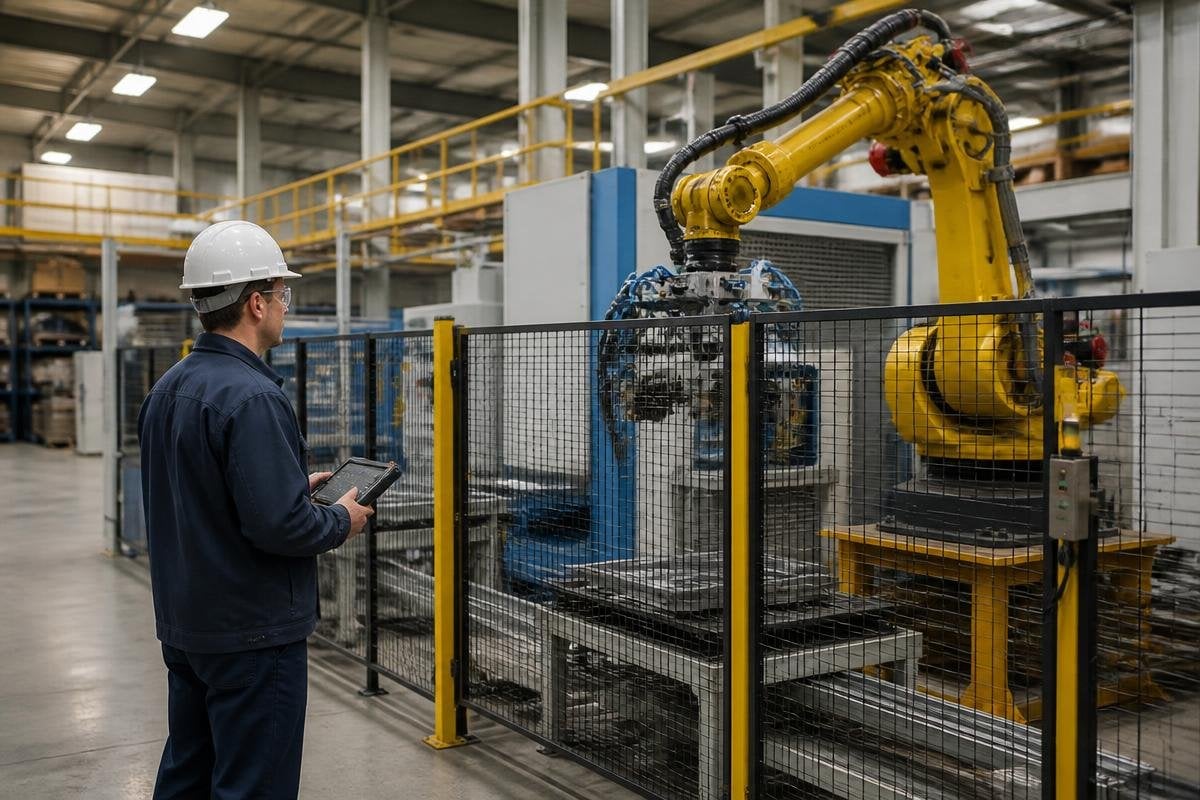
Factory robots can keep people away from heat, sharp tools, heavy loads, and repeated motion. The safety gain comes from how the whole work cell is designed, not from the robot arm alone.
- Robots can handle tasks that place people near heat, sparks, dust, or moving parts
- Sensors and barriers can stop motion when a person enters the work area
- Safe operation still depends on setup, training, maintenance, and clear procedures
Moving people away from the hazard
A robot can load a press, move parts through a hot process, or carry material between work areas. That changes where a worker stands during the task and can reduce contact with the source of harm.
The robot still needs a defined work cell. Guards, gates, floor markings, and controlled access help separate people from moving equipment. The layout also needs space for maintenance and a clear route out of the area.
This matters because many factory injuries happen during ordinary work: loading, clearing parts, checking a fault, or reaching into equipment. Automation can reduce those tasks, but it can’t remove the need for safe access when the system stops.
How the safety controls work
A factory robot uses several layers of control. A light curtain can detect a person crossing an opening.
A door switch can stop the cell when a gate opens. An emergency stop gives people a direct way to cut motion when something goes wrong.
Force and torque sensing can also help a robot detect contact. The controller can slow or stop the robot when the measured force passes a set limit. That response depends on the sensor, the software settings, the tool, and the speed of the movement.
Some systems run at a lower speed when a person enters a shared work area. This can help workers and robots operate near each other, but the reduced speed doesn’t make every contact safe. The task, tool shape, load, stopping distance, and position of the worker still matter.
A safety control is useful only when it works during the fault it was meant to handle. A blocked sensor, damaged cable, badly placed emergency stop, or changed robot program can leave a gap between the design and the real cell.
The work cell matters more than the arm
Robot safety starts with a review of the full task. That review should look at the robot, gripper, part, fixtures, conveyors, software, access points, and the actions a worker takes when production stops.
A gripper may hold a part securely during normal motion, then drop it after a power loss. A fixture may keep a part in place for one size, then leave a pinch point when the product changes. These details belong in the safety review because the hazard can come from the surrounding equipment rather than the arm.
Dated factory robotics safety reports can show how plants set up guards and stop circuits around working cells. Those cases give the safety review a point of comparison before maintenance work begins.
Maintenance creates another test. A technician may need to enter the cell, disable automatic motion, test the stop circuit, or work near stored energy. The safe procedure needs to cover those steps in plain language, with clear control over who can restart the equipment.
What automation can’t fix
Robots don’t remove risk from a factory by themselves. They can add new hazards through unexpected movement, stored energy, poor visibility, software faults, or a tool that behaves differently after a change.
The system also needs records of faults, stops, repairs, and program changes. Those records help a site find repeated problems before a small control failure becomes an injury. A safety review should happen again after the cell, product, tool, or program changes.
I’d treat any claim that a robot makes a factory safe as unfinished until the company explains the full work cell and its failure response.
A practical safety check
Use these questions before treating an automated cell as safer:
- Map the hazards: mark heat, sharp edges, pinch points, stored energy, and moving paths
- Test the stops: open each gate, cross each sensor, and press every emergency stop
- Check the restart: confirm who can reset the cell and what the robot does after power returns
- Review changes: repeat the safety check after a new part, tool, program, or layout
- Watch maintenance: give technicians a clear isolation procedure before they enter the cell
A safer factory is built when automation removes people from dangerous steps and the remaining work has clear controls. The next useful measure is simple: compare the task before and after the robot, then inspect every point where a person still enters the cell.
